
In this modern age of spending nearly every waking hour staring at artificially lit, glowing rectangles, it has become a radical act to simply observe nature. Smartphones bookend our sleep and bolster insomnia. Work happens for many within the confines of one or more computer monitors. Our downtime companions are televisions and tablets. The smartphones are ever-present throughout.
But what if you actually could let yourself unplug and immerse yourself in a little pocket of nature, a set physical boundary to return to regularly? Not as part of some major self-rebrand or lifestyle shift toward digital minimalism, but rather to just remind yourself that you are one small being in a universal ecosystem more interconnected than the internet itself.
That could be pretty neat.
Establish Your Patch
To start noticing a specific spot in nature on a recurring basis, step out into your yard. Take a ruler or your preferred measuring tool. Pick a spot you pass by often, but do not typically walk through. Measure out a 12-inch by 12-inch square. Approximation is fine, and you could even make the patch smaller if you prefer; just don’t expand it too large, as it will likely be harder to deeply engage with everything you’ll be studying. Mark the boundaries, or at least the corners, with sticks, stones, plastic dinosaurs, or your objects of choice.
Congratulations, you’ve established your patch.
What to Do If You Don’t Have a Yard
No yard to work with? Unable to get outdoors on a semi-consistent basis? Not a problem at all. A houseplant in your living space could make a good substitute, with its soil, stem(s), and foliage providing plenty of surface area to observe.
A window sill could also be good, particularly if yours is a spider-positive household that has a few cobwebs in unused corners. No judgment if bugs are generally unwelcome inside your home, of course. What makes you most comfortable and keeps you safe is what matters.
In that case, pick a spot outside a window. Maybe it’s a nearby tree open lot. If you are able to spend time outdoors but close to home, maybe there’s a small dirt patch you could watch. Perhaps there’s a sidewalk crack that shows signs of ant activity or plant life pushing through.
Whatever you do, just select a spot you can look at for a few minutes on a regular basis.
Enjoy Your Personal Microcosm
Okay! You’ve established your patch. Now make a habit of taking time to intensely observe it. This doesn’t have to happen every day, or at the same time every day, but that is one way to approach it. Hunker down close to the earth if it’s feasible. If it’s not, watch the spot from a position and distance that feels most comfortable to you. If your spot is a fairly far distance away (like in a tree outside your window), consider incorporating binoculars or a spotting scope to catch the fine details. If you’re observing from close up, a tool like a magnifying glass or jeweler’s loupe might reveal tiny discoveries the naked eye can’t easily catch.
Now, just focus on looking.
Your First Observation Session
It’s completely up to you on how you spend time observing your patch. Some things you might look out for are:
- Bug activity
- Plants that are present
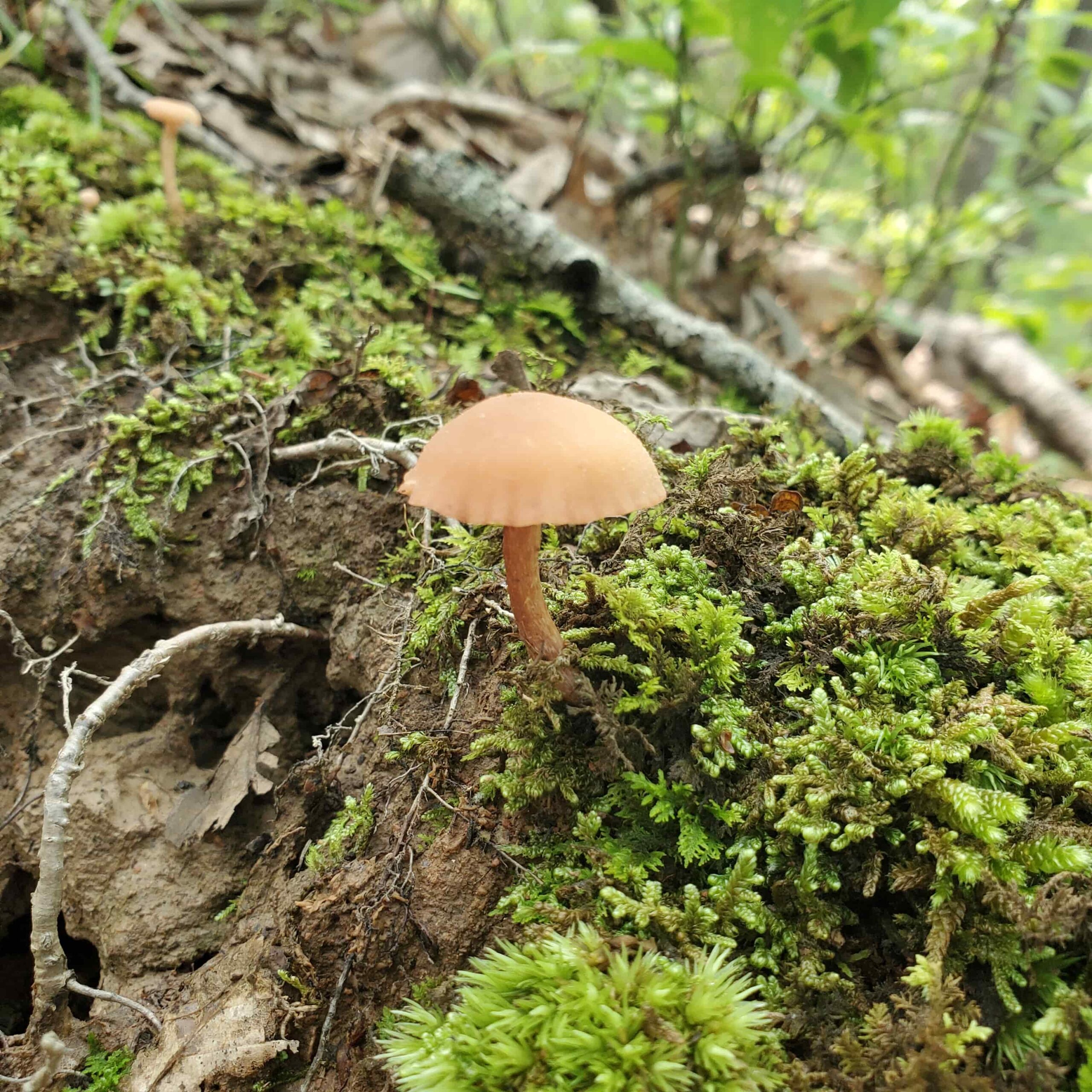
- Patches of fungi, moss, or lichen
- Whether or not there is dew or other moisture
- The quality of the natural light
Gaze intently around your patch. Spend several seconds or minutes studying every element you can distinguish. Disengage from everything else around you. Forget your smartphone exists entirely.
What are you seeing? Have you seen anything like it before? What are the textures of the scene? What are you smelling? Are there any movements or signs of the environment changing? How does it feel to be so still while sitting with nature? Are thoughts about the rest of your day sneaking in? What would it be like to just fully engage with the scene and nothing else?
Keep observing. Move, shift, or stim if you need to, but just keep watching until you feel you’ve reached a natural stopping point, or if distractions around you become impossible to avoid (it happens!).
Also, don’t interfere with the scene, if it’s possible. Refrain from moving a stick or unearthing a half-buried stone. Certainly don’t harass any wildlife that might be there, no matter the leg count. You’re there to watch passively, not create a commotion for local lifeforms.
Keep Coming Back
Once you’re done, resolve to come back and do the same thing in the same spot tomorrow. Or later that day. Or the same time next week. You get to control the frequency.
And when you do return, repeat the process of just fully engaging with the act of natural observation of a very small space. What changed since the last time you were here? What stayed the same? How is the environment different this time? What parts did you enjoy most? What parts created different feelings?
Continue looking with curiosity about both your little patch and the questions it’s raising within you. Maintain a consistent-but-flexible schedule of returning and observing, but don’t turn it into a chore. If ever it feels like this tiny practice isn’t working, remember that you are free to quit whenever you’d like. Don’t burn yourself out on such a small action.
Make Recordings (and Art)
If you’re feeling very motivated, you can jot down your findings in a notebook once you reach a good pausing point. You might also pause to take photos of any plants or bugs you see, to log them on iNaturalist or another citizen science app later. If you’re artistically inclined, make field sketches or little plein air paintings in an art journal. Take things one step further by bringing your notes, snapshots, or sketches home to turn them into major works of art on canvas or with other mediums. Freeform crochet? Sure! A diorama replicating the scene using found objects? Why not! A wonderscape of macrame and woven fibers? Of course!
Taking yet another step further, consider making a series of works that capture your patch across weeks or seasons, or perhaps a single work that shows the average of your patch’s activity and occupants across time. The possibilities of making art from the notes you take during your observation sessions.
Alternatively, you can just log sightings across time. This data is itself valuable in that it allows you (and any scientists you might opt to share it with via an app or other connection) to track patterns, spot anomalies, and predict future conditions. The more observations you collect, the better.
Benefits of Looking at Nature
There is something gently powerful about becoming intimately familiar with a sliver of the universe. You get attuned to lifeforms and their lifecycles that are both vastly different and jarringly similar to your own. Plant, bug, and animal activity you would never see otherwise becomes a wondrous occurrence. Life gets a little less boring and lonely, even if it looks to passersby that you are simply staring at the ground.
It’s certainly time better spent than staring at a phone screen.
The American Psychological Association notes a bevy of benefits around spending time outdoors, from improved cognition and stress reduction to increased feelings of happiness and prosocial behavior. Interestingly, the International Journal of Environmental Research and Public Health notes: “Social isolation is typically associated with worse subjective well-being. But the researchers found that when people with low social connectedness had high levels of nearby nature, they reported high levels of well-being.”
Certainly, too, there is something to be said for feeling more grounded, as well as watching things come and go as part of a mindfulness meditation practice. Additionally, the good brain chemicals connected with being outdoors or simply looking at nature, plus the cultivation of a sense of are, all serve to make nature observation that much more critical to making happier, more resilient humans (and/or goblins).
Now, go find yourself a patch of nature to stare at.